



Maryland Juvenile Defense Lawyer: Protecting Your Child's Future
When your child is arrested or contacted by the Department of Juvenile Services (DJS), the clock starts immediately. Maryland juvenile court is a civil court with criminal-style rights, its own vocabulary, and outcomes that can follow a young person for years. A delinquency finding is not the same as an adult conviction, but it can still mean detention, probation, school consequences, and a record that has to be cleared later.
At FrizWoods, juvenile defense is handled by juvenile crimes lawyers who have worked both sides of these cases. Luke Woods spent years as the lead juvenile public defender in Southern Maryland. Max Frizalone prosecuted serious juvenile felony cases in Prince George's County. That combination matters when the question is whether a case stays in juvenile court, whether DJS can keep it informal, or whether the State tries to move it to adult court.
If DJS just called, or your child is facing a detention hearing, get counsel involved before the intake decision hardens. Early work often decides whether the case ever reaches a courtroom.
Start here: Understanding juvenile law | Children charged as adults | Youth Charging Reform Act (SB 323) | Juvenile gun charges | Under-18 DUI | Juvenile expungement
Facing adult criminal charges instead? Our Maryland criminal lawyer hub covers the full range of adult cases we defend statewide.
Meet Our Maryland Juvenile Defense Lawyers

Max Frizalone
Juvenile defense informed by former prosecution in the Juvenile Division.
- Protects education, employment, and immigration interests.
- Seeks diversion and informal adjustments where possible.
- Addresses transfer/waiver issues and aftercare planning.

Luke Woods
Deep experience navigating juvenile courts and specialty dockets.
- Focus on rehabilitation-forward outcomes over punishment.
- Coordinates with family and providers for holistic plans.
- Protects confidentiality and long-term record interests.
Both partners bring courtroom experience that is hard to duplicate. Luke's decade of juvenile defense practice covers magistrates, judges, waiver hearings, and transfer hearings across multiple counties. Max's time as a juvenile prosecutor means he has already tried the kinds of cases the State files against older teens. Together they handle DJS intake, detention advocacy, adjudicatory hearings, disposition, and the adult-court fights that decide whether a child stays in the juvenile system.
Why Choose FrizWoods for Juvenile Defense
Juvenile court is not adult court with shorter sentences. The parties include DJS and the parents, the goals are rehabilitation and public safety, and the wrong move at intake can lock a child into a path that was avoidable. Here's how that experience shows up in your child's case:
Both sides of the aisle
Luke defended juveniles as a public defender. Max prosecuted juvenile felonies. We know how DJS, prosecutors, and magistrates actually evaluate these files.
Intake before court
Many cases are won or lost at DJS intake. We get involved early to push for informal adjustment when the statute allows it and to prepare when court is required.
Transfer and waiver fights
Keeping a case in juvenile court can be the entire case. We handle Section 4-202 transfer motions and Section 3-8A-06 waiver hearings as dedicated litigation, not as an afterthought.
Detention advocacy
We appear at detention hearings, argue for release to parents or community detention, and challenge placements that are not required by the facts.
Statewide juvenile courts
Prince George's, Anne Arundel, Howard, Calvert, Charles, Montgomery, and Baltimore-area courts. We know the local juvenile calendars.
24/7 attorney line
Call (877) 343-1031 any hour. Arrests and DJS contacts do not wait for business hours, and neither do we.
Parents as partners
Parents are parties in juvenile cases. We keep families informed, prepare them for hearings, and build disposition plans courts can accept.
Record cleanup
When the case ends, we talk about juvenile expungement and what it takes to clear the record so the charge does not follow your child into college or a job.
How We Build a Juvenile Defense
Every case has different facts, but the process for protecting a child's future is consistent:
DJS intake
We engage the intake officer early, present mitigation, and push for informal adjustment on eligible cases so the child never gets a petition.
Detention hearing
If your child is held, we argue for release, community detention, or conditions that keep the case at home while it is pending.
Transfer motions
When a case starts in adult court, we file under Criminal Procedure Section 4-202 to move it down to juvenile court when the law allows.
Waiver defense
When the State wants to waive a juvenile case up to adult court under Section 3-8A-06, we litigate amenability, public safety, and the statutory factors.
Adjudicatory hearing
The State must prove involvement beyond a reasonable doubt. We challenge the stop, the search, the identification, and the witnesses.
Disposition
If the court finds involvement, we fight for probation, counseling, and community-based plans instead of commitment whenever the facts support it.
Constitutional issues
Unlawful stops, illegal searches, and coerced statements still matter in juvenile court. Suppression can end a case before disposition.
Expungement path
We plan the endgame from day one so a resolved case can be cleared under Maryland's juvenile expungement rules when your child becomes eligible.
How Maryland Juvenile Court Works
Juvenile Court is a special jurisdiction carved out of Circuit Court to handle delinquency. The case is civil, but after a series of Supreme Court decisions the child (called the "respondent") has nearly all of the rights an adult defendant would have, with the major exception of a jury trial.
If a child is accused of an offense such as motor vehicle theft, the process typically looks like this:
- Arrest or citation, followed by release to parents or detention.
- DJS intake, where an intake officer decides whether the case goes informal, is closed, or is petitioned into court.
- Adjudicatory hearing, the juvenile equivalent of a trial, where the State must prove the child is "involved" beyond a reasonable doubt.
- Disposition, the sentencing-type hearing, where the State must also show the child is in need of guidance, treatment, or rehabilitation.
- Delinquency finding and plan, if both burdens are met, followed by probation, services, or commitment.
For a visual of that path, see the flow chart below.
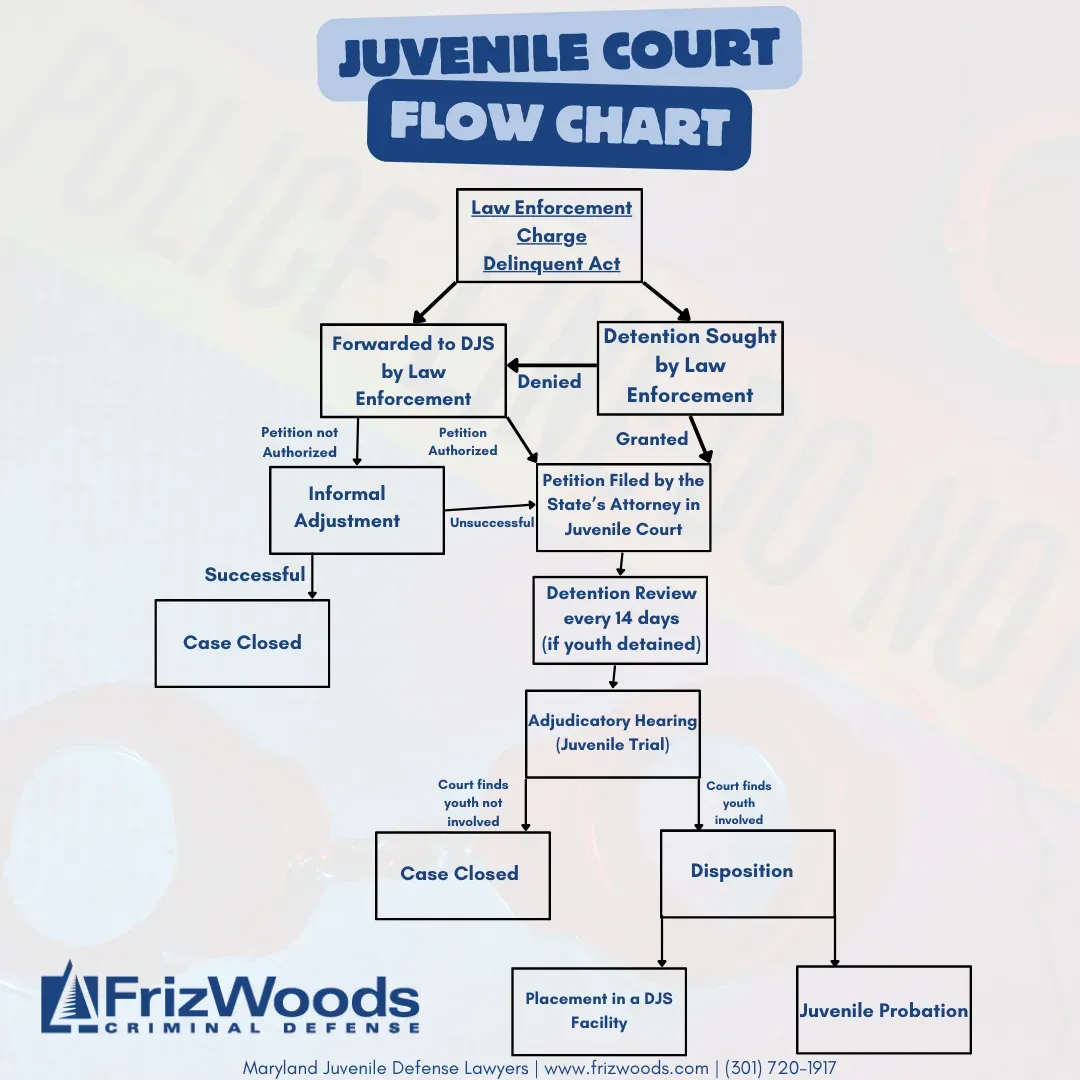
For serious cases that must go to court by statute, informal adjustment is off the table. For minor offenses, DJS can propose an informal resolution if the parties agree, which can keep a juvenile record from ever forming. Having a juvenile defense attorney at that stage puts the child in the best position to request informal handling and to prepare if court is unavoidable.
Juvenile law keeps changing. Maryland's 2022 juvenile justice reform reworked detention and probation rules. In 2026, the Youth Charging Reform Act (SB 323) pulled most serious 16- and 17-year-old cases back into juvenile court starting October 1, 2026.
Can a Child Be Charged as an Adult in Maryland?
Some cases still start in adult court. Others start in juvenile court and the State asks to waive them up. Both doors matter, and SB 323 changed which door most teenagers walk through.
Auto-adult cases after SB 323
Effective October 1, 2026, the auto-adult list for 16- and 17-year-olds is much shorter. The offenses that still start in adult court include:
- Crimes punishable by life imprisonment
- Second degree murder
- Manslaughter other than involuntary manslaughter
- Second degree rape
- Carjacking and armed carjacking
- Attempted second degree murder
- Attempted second degree rape
- Use of a firearm in the commission of a felony or crime of violence
Offenses that used to auto-adult older teens, but no longer do under SB 323, include robbery, first degree assault, abduction, kidnapping, wear/carry/transport handgun under Section 4-203, and most regulated firearm possession cases. Those matters now start in juvenile court unless the State wins a waiver.
Transfer vs. waiver
- Transfer: the case starts in adult court, and the defense asks the judge to send it down to juvenile court under Criminal Procedure Section 4-202. The defense carries the burden.
- Waiver: the case starts in juvenile court, and the State asks the judge to send it up to adult court under Courts and Judicial Proceedings Section 3-8A-06. The State carries the burden.
After October 1, 2026, most serious teenage cases start in juvenile court, which means the State usually has to file the waiver motion. That shift in burden is one of the biggest practical changes in Maryland juvenile practice in years. Our children charged as adults guide walks through the hearing factors in more detail.
Types of Juvenile Cases We Handle
Juvenile gun charges
Handgun possession, ghost guns, and school-related firearm allegations. See our juvenile gun charges guide and minor in possession of a firearm page.
Under-18 DUI
Alcohol-related driving cases for minors have different MVA and court consequences than adult DUI. Start with our Under-18 DUI page.
Assault and fights
School fights, domestic-type assaults, and serious injury cases. We defend both the juvenile petition and any adult-court filing that follows.
Theft and car theft
Shoplifting, unauthorized use, and motor vehicle theft are common juvenile petitions. Early intake work often changes the outcome.
Robbery and carjacking
These used to auto-adult many 16- and 17-year-olds. Under SB 323, more of them start in juvenile court, where transfer and waiver strategy is critical.
Drug cases
CDS possession and distribution allegations involving minors. Disposition often turns on treatment plans and school stability.
Detention and community detention
We fight unnecessary detention and work for release conditions that keep the child at home while the case is pending.
Record clearing
After the case ends, we pursue juvenile expungement when your child becomes eligible so the petition does not follow them forever.
What Happens at Disposition
Juvenile respondents are not sentenced the way adult defendants are. At disposition, DJS presents a rehabilitative plan, and the child's attorney and the State argue about what the court should order. Common outcomes include:
- Probation with conditions such as curfew, counseling, or drug testing
- Community service
- Restitution in limited cases
- Placement outside the home when the court finds no safe community option
Judges weigh the seriousness of the offense, the child's age, prior history, school performance, and the Predisposition Investigation (PDI) that DJS prepares. A lawyer's job at this stage is to give the court a plan that protects public safety without destroying the child's future.
Frequently Asked Questions About Maryland Juvenile Defense
Do I need a juvenile defense attorney if DJS just called?
Yes. Intake is often the best chance to keep a case informal and out of court. Once a petition is filed, the options narrow. A juvenile defense lawyer can talk to the intake officer, gather school and counseling records, and position the case before the decision is made.
Is a juvenile case a criminal conviction in Maryland?
No. Juvenile court is civil, and a delinquency finding is not an adult criminal conviction. It can still create a juvenile record, probation conditions, detention, and school or licensing problems, which is why fighting the petition and planning for expungement matter.
Can my child get a jury trial in juvenile court?
No. Juvenile adjudicatory hearings are bench trials before a magistrate or judge. The State still has to prove involvement beyond a reasonable doubt, and the child still has counsel, confrontation, and the privilege against self-incrimination.
What is the difference between transfer and waiver?
Transfer moves a case from adult court down to juvenile court on a defense motion under Criminal Procedure Section 4-202. Waiver moves a case from juvenile court up to adult court on a State motion under Section 3-8A-06. After SB 323, more cases start in juvenile court, so waiver fights become more common.
What changed under Maryland's Youth Charging Reform Act?
Starting October 1, 2026, most serious charges against 16- and 17-year-olds begin in juvenile court instead of adult court. Only a short list of the most serious offenses still auto-file as adult cases. Read our full breakdown of the Youth Charging Reform Act (SB 323).
Can a juvenile record be expunged in Maryland?
Often yes, depending on the offense, the outcome, and waiting periods. Our juvenile expungement guide covers eligibility. Expungement planning should start while the case is still open, not years later.
What should parents do after a juvenile arrest?
Do not let your child give a statement without counsel. Ask where the child is being held, call a juvenile lawyer immediately, and gather school records, counseling history, and any proof of community ties for the detention or intake meeting.
How is a Maryland juvenile defense lawyer different from a regular criminal lawyer?
Juvenile court has different statutes, different deadlines (including the James Date speedy-trial clock), DJS as a central player, and disposition rules built around rehabilitation. Experience in adult criminal court helps, but juvenile practice is its own specialty.
Related Juvenile Law Guides
- Finding a juvenile criminal defense attorney
- Understanding juvenile law
- Children charged as adults
- Youth Charging Reform Act (SB 323)
- Juvenile law updates and the new juvenile bill
- Juvenile gun charges and minor in possession of a firearm
- Under-18 DUI
- Juvenile expungement
Juvenile Defense Across Maryland: Find Your County
We handle juvenile petitions and related adult-court filings throughout central and Southern Maryland:
Prince George's County
Anne Arundel County
Howard County
Calvert & Charles
Montgomery & Baltimore Area
Related Spokes
Client Reviews
A few reviews from families and clients who worked with us on cases involving children or young adults. The full set lives at our reviews page.
Related Juvenile Defense Resources
Core Juvenile Guides
Charge-Specific
Process & Records
Related Practice Areas
Our Juvenile Defense Office Locations
Upper Marlboro Office
14513 Main Street, Ste B, Upper Marlboro, MD 20772
Phone: (301) 720-1917
Get directions on Google Maps
Columbia Office
6304 Woodside Court, Suite 110, Columbia, MD 21046
Phone: (410) 346-9384
Get directions on Google Maps
Severna Park Office
540 Ritchie Hwy Suite 301, Severna Park, MD 21146
Phone: (410) 883-5667
Get directions on Google Maps
Chesapeake Beach Office
9120 Chesapeake Ave #201, North Beach, MD 20714
Phone: (877) 343-1031
All offices available by appointment. Call our 24/7 attorney line at (877) 343-1031 after a juvenile arrest or DJS contact.
Talk to a Maryland Juvenile Defense Lawyer
DJS intake decisions and detention hearings move fast. Talk to a lawyer who has defended juveniles and prosecuted juvenile felonies before the next hearing locks in a path you cannot undo. The first call is free.
Call 24/7: (877) 343-1031